Information processing
News
2025, 24, 50, Ahmed Al Ahmad: The Risk Taker, Bondi Beach, but, Chanukah by means of the ocean, December 14, father-and-son duo, Hero of Bondi, I'd have been safe, If I ran away, Naveed Akram, older gunman, On Sunday, public birthday celebration, Sajid Akram, striking Ahmed twice—first, Where is Bondi Beach?, why take a risk?
Ali Haider
0 Comments
SHATTERED PARADISE: Terror, Heroism, and the Light That Remains at Bondi Beach
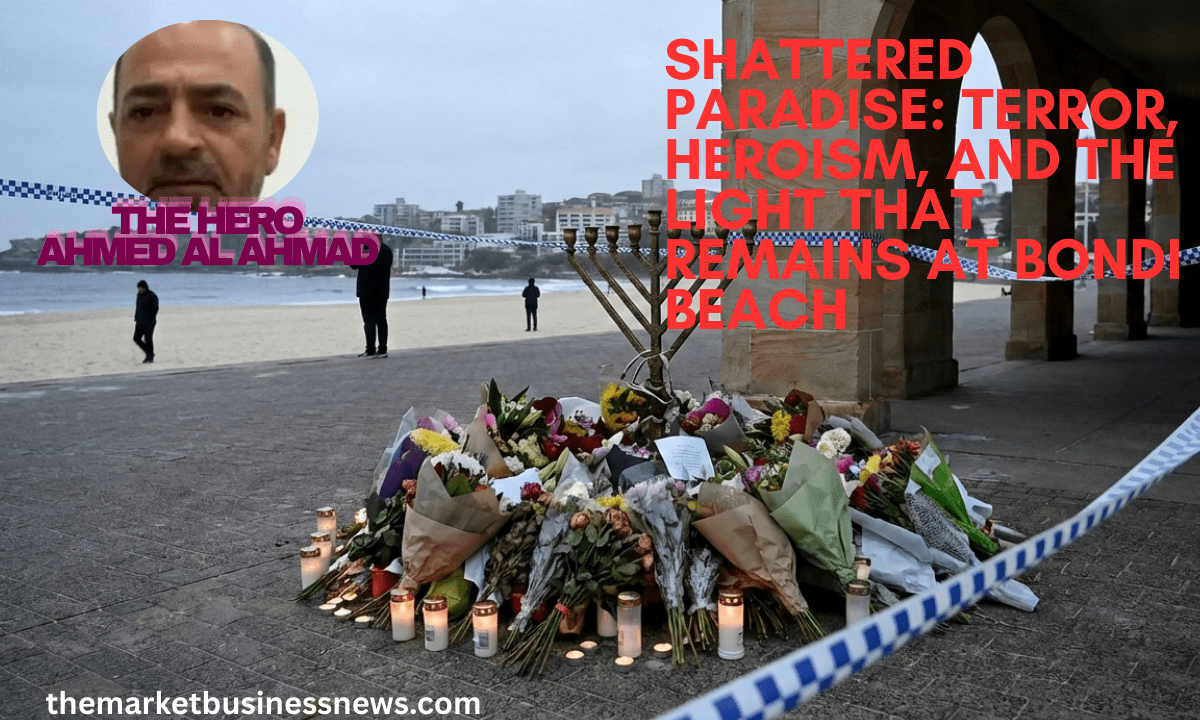
The sun rose over the Pacific Ocean this morning, casting its familiar golden glow upon the white sands of Bondi Beach. Surfers paddled out into the breaks, and joggers took to the coastal stroll, their breaths misting inside the early air. To the informal observer, the rhythmic crash of the waves sounded similar to the way it normally does. But, in recent times, the roar of the ocean competes with a deafening silence that has descended upon Australia’s maximum iconic coastline.
Two days ago, the sector-famous sands of Bondi were stained through a tragedy that has left the state reeling. What commenced as a party of mild—a Hanukkah collecting intended to mark the primary night of the Jewish competition—descended into darkness at the same time as gunfire erupted close to the Bondi Pavilion.
Within the aftermath of the Bondi seaside shooting, the arena is raising tough questions. We are searching for solutions approximately the Bondi Beach shooter identity, mourning the victims of Sydney’s Bondi seaside assault, and looking to understand the sheer bravery of a man named Ahmed Al Ahmad, whose split-second decision to threaten everything has redefined our appreciation of heroism.
That is the story of a paradise lost and determined once more via the bravery of strangers. That is the story of where darkness met light.
The destination and the Desecration
Where is Bondi Beach?
To apprehend the importance of the violation that took place on Sunday, one needs to first apprehend the canvas upon which it used to be painted.
Where is Bondi seashore? It is not merely a vicinity; it is a country of the mind for Australians and a bucket-listing dream for international travelers. Located simply 7 kilometers (four miles) east of the Sydney Central Business District, it is the crown jewel of the Japanese Suburbs. It’s a crescent of golden sand stretching one kilometer among 2 headlands, protecting the vastness of the Tasman Sea.
For decades, Bondi has been synonymous with the Australian way of life—egalitarian, open, and loose. It’s far in which metropolis existence meets the sea, a place wherein bankers strip off their suits to surf along students, travelers, and retirees. It is an area that belongs to every person.
Bondi Tourist Attractions: A Canvas of Joy
Before the police tape and the floral tributes, the region was buzzing with the vibrant electricity that defines Bondi tourist sights.
traffic flock right here not only for the swim, however for the lifestyle. The Bondi to Coogee Coastal walk is possibly the most famous seaside trek in the United States of America, winding alongside sandstone cliffs with dramatic perspectives of the sea, passing Tamarama and Bronte seashores. It’s a direction normally full of laughter, selfies, and the awe of nature.
At the southern end lies the Bondi Icebergs, the historical ocean pool where waves crash over the concrete partitions, filling the lanes with sea water. It’s far the most photographed pool in the world, an image of resilience towards the factors. The Campbell Parade strip, lined with surf shops, gelato stands, and bars, is the pulse of the suburb’s social scene.
On Sunday, December 14, 2025, the enchantment was once religious in addition to bodily. The local Jewish network had organized a “Chanukah by means of the ocean” occasion close to the grassy knoll, a public birthday celebration of spiritual freedom and pleasure. families had accumulated with picnic blankets. Children were ingesting doughnuts. The primary candle of the Menorah was once ready to be lit.
It was into this postcard-ideal scene that the Bondi seashore attack was launched, shattering the illusion that splendor can shield us from brutality.
The Attack
The Day the Music Stopped
At about five:15 PM, the festive environment used to be pierced with the sound of a legitimate firework that witnesses, to start with, mistook for fireworks. It was as soon as a pointy, cracking noise that echoed off the Art Deco façade of the Bondi Pavilion.
Panic ensued in seconds.
Steady with New South Wales Police Commissioner Karen Webb, two gunmen, armed with high-powered rifles, opened fire on the crowd attending the Hanukkah celebration. The assault was once quick, calculated, and brutal.
“It used to be absolute chaos,” stated Sarah Jenkins, a vacationer from the UK who was at the coastal walk at the time. “One minute, people have been creating a tune, and the following, some people were screaming, taking walks inside the path of the water, hiding within the back of the sea partitions. You couldn’t inform where the photographs had been coming from.”
The Bondi seashore, taking pictures used to be not a random act of insanity, but a targeted assault. The gunmen positioned themselves to inflict maximum casualties on the collected families. For ten agonizing minutes, the maximum well-known beach in the world became a kill field.
The Bondi Beach Shooter Identity
In the 40-8 hours following the assault, investigators have labored tirelessly to find the identities of those responsible. Police have now shown the Bondi seashore shooter identification as a father-and-son duo: Sajid Akram, 50, and Naveed Akram, 24.
Sajid Akram, the father, was killed on the scene during a shootout with police. His son, Naveed, was as soon as seriously injured and is nowadays under heavy protection at a Sydney health facility.
The government has defined the attack as ideologically prompted, citing antisemitic substances found on the suspects’ Western Sydney home. “This was a cold-blooded attempt to intimidate and slaughter a particular network on our soil,” Prime Minister Anthony Albanese said in a press conference the day before today. “However, in their attempt and divide us, they have only discovered the cracks in their own hateful ideology.”
However, even as the identification of the shooters provides a name to the evil, it’s the identity of the person who stopped them that has captured the sector’s heart.
The Hero of Bondi
Ahmed Al Ahmad: The Risk Taker
In every tragedy, there may be a split second where history holds its breath. A second is where a bystander ought to determine whether or not to run for safety or to run towards danger.
On Sunday, that decision fell to Ahmed Al Ahmad.
Ahmed isn’t a soldier. He isn’t always a police officer. He is a 43-12 months-antique father of two who owns a small fruit and vegetable store in Sutherland Shire. He was at Bondi seashore that day, sincerely to enjoy the afternoon along with his circle of relatives, nowhere near the Hanukkah event but near ample to hear the screams.
Whilst the shooting started, Ahmed did not flee. Witnesses—and now viral video photos—show Ahmed sprinting closer to the gunfire.
“I saw a person with a gun,” Ahmed instructed journalists from his health facility bed this morning, his arm heavily bandaged. “I did not see a faith. I failed to see politics. I noticed toddlers. I noticed mothers. And I saw a man trying to kill them.”
Bondi Beach: Why Take Risk?
The question resonates throughout social media and living rooms globally: Bondi Beach, why take a risk? Why did a person with the whole thing to lose—a spouse, toddlers, an enterprise—charge at an armed terrorist with not anything but his naked fingers?
In the video, Ahmed may be seen flanking the older gunman, Sajid Akram, while he used to be reloading. With the whole brush aside for his very own existence, Ahmed tackled the gunman from behind, wrestling the rifle from his grip. During the conflict, the second gunman, Naveed, fired at them, striking Ahmed twice—first in the top arm and as soon as within the hand.
Notwithstanding his injuries, Ahmed managed to pin the gunman down until police arrived seconds later. His movements undoubtedly saved dozens of lives.
While requesting “why take the hazard,” Ahmed’s solution was easy. “If I ran away, I’d have been safe, but I would have died internally. To stay with the understanding that I may want to have stopped it… that could be a hazard I couldn’t take.”
His cousin, Mustafa, spoke to the press outside the clinic. “Ahmed is a Muslim. The people being attacked were Jewish. To Ahmed, this doesn’t matter. We’re all Australian. We are all human. He’s someone who illuminated our lives before this, and now he has illuminated the arena.”
PART IV: The Victims
The People Who Illuminated Our Lives
At the same time as we have fun, the hero who survived, we need to solemnly consider the individuals who did not. The loss of life toll stands at 12, with dozens more injured. The Bondi seashore, taking pictures, sufferers have been a part of the network, united in party, and now united in tragedy.
Because the coroner releases names, the heartbreak deepens. These had no longer been simply records; they had been the material of our society.
The Holocaust Survivor, a number of the useless, is ninety two-12 months-old Elara Klein, a female who survived the horrors of Auschwitz as a teenager. She had immigrated to Australia in 1948, looking for a haven of peace at the end of the world. That she must perish in a violent act of hatred at the sands of Bondi is a cruel irony that has devastated the country. Her grandson, David, described her as “indestructible,” a girl who taught her family that love is the only revenge really worth seeking.
The Rabbi Rabbi Yossi Feldman, 45, a cherished network chief acknowledged for his charity work and infectious sense of humor, used to be killed while shielding his children. Witnesses say he pushed his family to the ground and protected them together with his personal frame. He was once a person who illuminated our lives, an instructor who preached unity among faiths. His very last act was considered one of remaining love.
The kid, possibly maximum heartbreaking, is the death of 10-year-old Maya Turner. Maya used to be journeying Sydney from Melbourne for the holidays. She was carrying a dress with flickers on it, excited to mild the candles. Her life, complete with unwritten chapters and unrealized goals, was extinguished in an instant.
There are others—a younger nurse who stopped to help the wounded and was shot, a grandfather who refused to leave his wife’s side. each of the sufferers of Sydney’s Bondi seashore assault leaves in the back of a void which could in no way be filled.
PART V: Analysis and Aftermath
A Nation in Reflection
The Bondi seashore attack has pressured Australia to look in the mirror. For years, this u. s . has prided itself on strict gun laws and a relative absence of the mass violence that plagues different nations. The reality that high-powered weapons were used in this assault has prompted a direct review of gun licensing and border safety.
However, beyond the politics, there may be a social reckoning. The photograph of Ahmed Al Ahmad, a Muslim man, bleeding on the pavement after saving a Jewish man, has grown to be a powerful symbol against the very hatred the gunmen attempted to incite.
“They wanted a combat among cultures,” stated NSW Premier Chris Minns. “Rather, they gave us an image of our unbreakable harmony. Ahmed did not just disarm a gunman; he disarmed the ideology of hate.”
The Healing of Bondi
Nowadays, the police tape is slowly being peeled back. The Bondi traveler points of interest are quiet; however, they are no longer closed. A big vigil is deliberate for this night at the Bondi Pavilion. Heaps of flora have already been laid on the prom, developing a river of colour in opposition to the grey pavement.
Surfers have organized a “paddle out” for the following morning—a conventional Hawaiian tribute where surfers form a circle in the ocean, placing their hands to honor the dead. It’s miles a reminder that while the sand may be stained, the ocean washes everything easily.
Bondi is more than a seashore. It is a testimony to the Australian spirit. It’s miles the place in which we go to experience the sun, to taste the salt, and to be unfastened. The moves of the shooters tried to turn it into a place of worry. But the actions of Ahmed Al Ahmad, and the memory of sufferers like Elara, Rabbi Feldman, and little Maya, have ensured it stays an area of affection.
Conclusion: The Risk of Hope
In the end, we go back to the question: Bondi Beach, why take risks?
We take the risk of loving our pals, even if they appear distinct from us. We take the threat of standing as much as hatred, even when it’s miles armed. We take the danger of desire, even if the arena seems dark.
As night falls over the Pacific tonight, the primary candle of Hanukkah could be lit once more at Bondi. It’ll flicker in the sea breeze, a tiny, defiant light in opposition to the massive darkness. It will burn for the victims. It’ll burn for the hero in the sanatorium. And it’s going to burn for anybody, a signal to the sector that terror might also visit our beaches; however, it will by no means overcome our souls.
Bondi seashore is wounded, but it is still lovely. And, way to the bravery of a few, it remains ours.












Post Comment